
Federal BOP Release Scope
The Federal Bureau of Prisons runs a nationwide prison system for people committed to federal custody. No federal correctional institution was identified inside Panola County. A federal defendant may be held temporarily in a local or contract facility, but that alone does not make the person a BOP prisoner. The U.S. Marshals Service generally controls pretrial federal detention and movement. BOP becomes the right public locator chiefly after commitment to a federal sentence.
A Panola County booking marked “released to USMS” records a transfer out of county custody. It does not mean return to the community. Likewise, a BOP release date means the person's BOP confinement ended. Federal supervised release, a state warrant, another sovereign's detainer, or ICE custody may follow. Keep each custodian's event separate.
Confirm Federal BOP Release
The BOP Inmate Locator accepts a federal register number or biographical details. A register number offers the strongest match. When searching by name, compare age, race, sex, and any number shown, but never use a photograph or one descriptive trait alone to decide identity. BOP says its locator includes federal inmates released after 1982.
- Confirm that the case produced a federal sentence, not only a county booking or USMS pretrial hold.
- Search the federal register number when known; otherwise enter the exact first, middle, and last name.
- Compare the result's name, register number, age, race, and sex with independent case identifiers.
- Record the displayed location or the exact released-status wording and release date.
- Check the federal court record or appropriate agency when supervision, a detainer, or later custody may exist.
Save the access date and query. A future date may change as federal credits or sentence data are recalculated. A past date is stronger evidence that BOP custody ended, but it does not speak for every other government system.
Read Federal BOP Release Results
BOP's locator record definition explains what its public result can show, while its inmate communication information supplies the agency's broader custody context. The fields are concise. Interpret them as a federal custody record, not a full account of the criminal case or all supervision after release.
| BOP field | What it establishes |
|---|---|
| Name | The identity used in the federal record |
| Register number | The best key for one BOP record |
| Age, race, and sex | Secondary match details, not stand-alone proof |
| Location | The BOP institution or placement shown for current custody |
| Release date | A projected or past date concerning BOP custody |
| Released / Not in BOP custody | The person is no longer held by BOP, subject to result context |
| UNKNOWN | The confinement term is undetermined in the locator |
A past release date with no institution can support release from BOP. It cannot show whether federal supervision began, whether another agency took custody, or where the person went. First Step Act credit recalculations can alter projected dates, so distinguish a future locator field from a completed past event.
Note: Quote the exact BOP status and date instead of translating “Not in BOP custody” into an unsupported claim of complete freedom.
Federal BOP Locator Evidence
The official BOP locator screen provides the federal search fields and released-result format documented for this Panola County project.
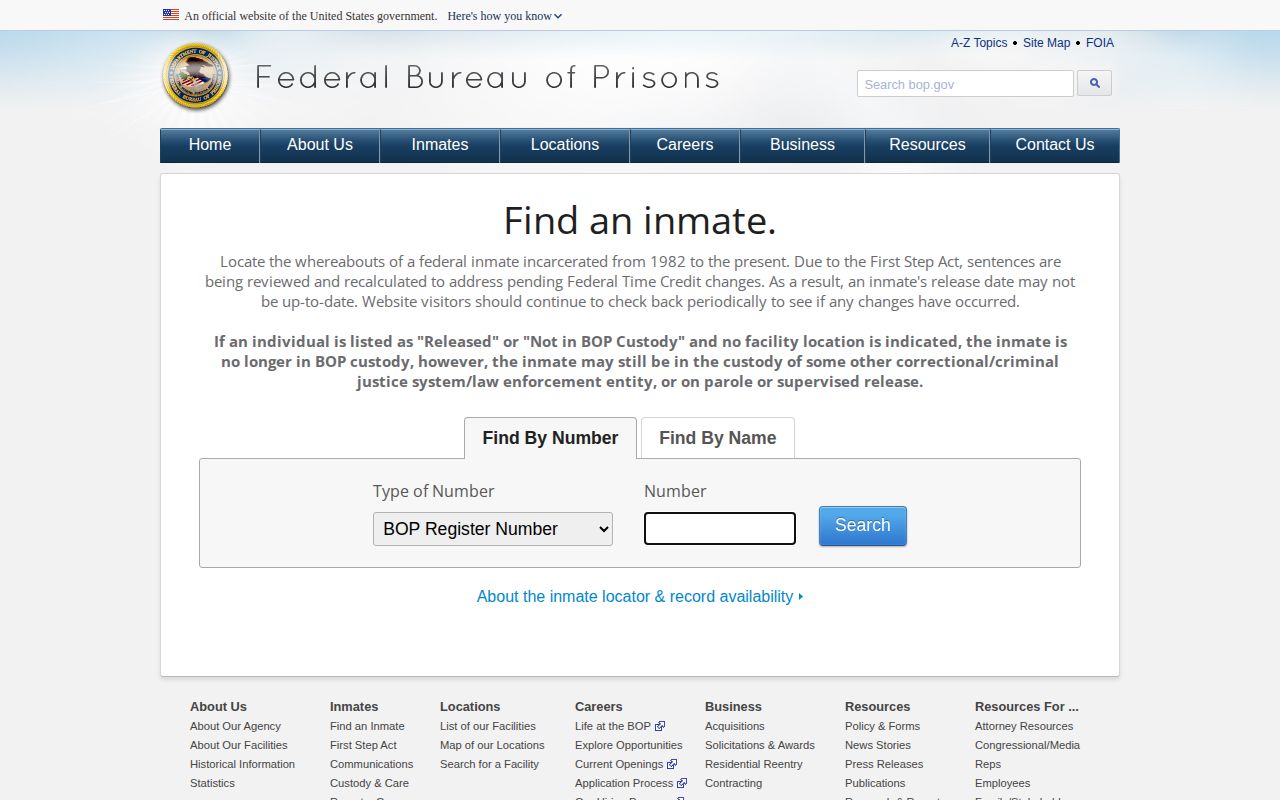
The capture shows why the locator is useful for a former federal prisoner yet still limited to BOP's own custody. Preserve the result wording and follow any custody handoff through the named receiving system.
After Federal BOP Release
A person can leave a BOP institution for the community, a residential placement reflected by BOP, another custodial authority, or immigration processing. Federal supervised release is administered by the U.S. Probation Office, not MDOC Community Corrections. A BOP result does not describe the terms of that supervision. The sentencing judgment and federal docket provide the legal framework.
If a state warrant or detainer exists, the person may move directly to state or local custody. When immigration action follows, ICE records become the next check. Use the receiving agency's record for the later event rather than asking BOP to certify another system's status. The earlier BOP release date remains the endpoint for BOP custody only.
| Displayed event | Next source |
|---|---|
| Past BOP release date | Federal court judgment and supervision record |
| Transfer to state or local authority | Receiving jail or state corrections locator |
| Immigration handoff | ICE locator or ERO contact |
| USMS pretrial custody | Federal district, court docket, counsel, or holding facility |
Federal USMS Transfer Records
The U.S. Marshals prisoner guidance is the proper starting point when Panola records show release to USMS or the person is a federal pretrial detainee. USMS does not offer the same broad public historical locator as BOP. Location information is generally sought through the relevant federal district or holding facility, with the federal docket used to identify the case and responsible court.
Ask the Panola County Sheriff's Records Clerk for the transfer date, receiving agency, and warrant or detainer reference when public. Then use the federal case number in the correct district. A BOP no-result in this setting is unsurprising and must not be reported as proof that federal custody ended.
Note: “Released to USMS” means Panola stopped holding the person while federal custody continued under a separate authority.
Obtain Federal BOP Release Records
For a quick public record, preserve the BOP result with the register number, exact status, release date, search date, and locator URL. For legal authority and supervision terms, obtain the federal sentencing judgment and later docket entries from the court. For a detailed BOP custody-ending record, identify the person by register number and ask BOP through its official records channel for the specific releasable release or custody-status record. No fee, response time, or local BOP records office was established in the Panola research, so none should be assumed.
If the chain began at the Panola County Detention Center, request the sheriff's jail-docket fields separately. Those fields should state when Panola custody ended and which agency received the person. They do not replace the later BOP record. Conversely, a BOP date does not supply the county transfer timestamp or legal reason recorded in the jail docket.
- Commitment
- Placement under a federal sentence after the court orders BOP custody.
- Transfer
- Movement between custodians without return to the community.
- Supervised release
- A federal court-ordered term in the community after confinement.
- Detainer
- A hold or request from another authority that can affect destination.
Federal BOP Release Contacts
There is no BOP institution in Panola County to call as a local facility. Use the nationwide locator for a committed federal prisoner and the U.S. Marshals guidance for pretrial custody. A federal court docket identifies the district, judgment, and supervision term. The Panola sheriff remains the source only for a county booking's transfer out.
Federal Bureau of Prisons
Nationwide Inmate Locator
Search by register number or biographical details
U.S. Marshals Service
Custody and Detention Guidance
Use the relevant federal district or holding facility
For a broader named-person workflow across county, state, and federal systems, use the Panola County release search. That distinction keeps a federal result from being applied to an ordinary county case.
Federal BOP Release Date Changes
A future BOP date is not the same kind of evidence as a past date paired with a released status. Federal sentence calculations can change when credits are recalculated, a court amends a judgment, or another legal event affects the confinement term. The BOP record-definition page notes that First Step Act credit recalculations can alter projected dates. Record the date as displayed and label it projected when it lies in the future.
For a completed event, compare the locator with the federal judgment and later docket entries. The judgment explains the sentence and any supervised-release term. The locator addresses BOP custody. A release notice or BOP status record can add the actual custody endpoint. None of those documents proves that a state detainer or immigration transfer did not follow. Check the next custodian only when the record points to one.
Uncertainty should remain visible. “BOP displays a future release date” is precise. “BOP lists a past release date and no current location” is also precise. “The person is free” reaches beyond both records. If the locator shows UNKNOWN, report that the federal confinement term is undetermined in the public result and seek clarification through the responsible official channel.
Identity must remain stable across each check. Use the register number with the name, then compare the federal case number when obtaining court records. Similar names or a changed age display should prompt another identifier check, not a guess.
Note: Preserve separate dates for the federal judgment, BOP custody ending, and any later transfer or supervision start.